
Local Truth and Canonical Collapse
A speculative essay on how canonical digital systems collapse variance, leaving human memory as the last carrier of locally true but unverifiable experiences.
A Speculative Thought Experiment on Memory, Canon, and Provenance
Tinkering with Time, Tech, and Culture #37
Abstract
This document explores a class of Mandela Effect–like experiences through the lens of continuity, documentation, and provenance failure. Rather than asserting multiverse physics, it proposes a bounded explanatory model in which canonical cultural artifacts converge to a single authoritative branch while human memory—specifically procedural memory—retains variants that become globally unverifiable.
To maintain epistemic honesty, this paper employs specific terminology: Canonical Convergence (artifact normalization), Human-Only Variant Retention (HOVR) (memory-resident variants), and Local Truth (internally consistent but externally unverifiable experiences). This paper is a thought experiment about documentation failure modes, not a claim about altered physical history.
Motivation
Modern digital systems increasingly privilege exact strings, centralized authority, and update-in-place truth. Articles are silently revised, videos are replaced without versioning, software behavior is retroactively declared “always that way,” and search results collapse to a single sanctioned answer. At the same time, people report persistent memories of variants that can no longer be located in any authoritative database.
This paper treats these reports not as evidence of supernatural events, but as symptoms of a structural shift: lived experience is being overwritten by systems optimized for canonical consistency rather than historical completeness. The question is not whether memory is fallible—it is whether the systems we rely on are still capable of preserving variance at all. The mechanisms by which variance collapses, substrates diverge, and provenance disappears are illustrated schematically in Figures 1–3.
Canonical Convergence (Artifact Collapse)
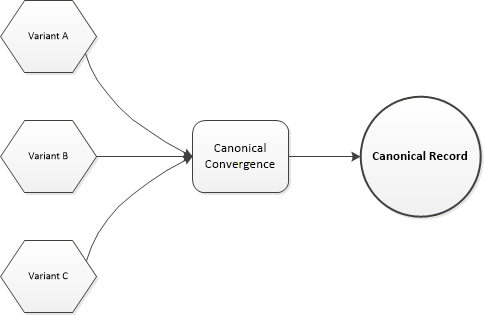
This collapse is not driven by a single actor, but by convergent pressures: legal risk minimization, search engine ranking, dataset deduplication, licensing consolidation, and economic incentives favoring a single “Prime” artifact. The result is a system that optimizes for authority and consistency at the expense of traceable history.
After convergence, variants persist only in non-indexed substrates, such as human memory, outside the reach of canonical retrieval systems.
Substrate Evolution: From "Sticky" Physicality to "Lossy" Cloud
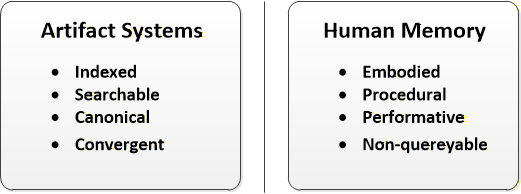
Artifacts and human memory operate on distinct substrates, a divergence made explicit in Figure 2, which contrasts embodied procedural memory with centrally managed canonical records.
- Human Memory: An embodied, performative system that preserves continuity rather than indexed facts.
- Declarative vs. Procedural: Facts (declarative memory) are easily corrected by reference; performed actions such as singing, speech cadence, or breath timing (procedural memory) are resistant to overwrite.
The acceleration of convergence is tightly coupled to the migration from Physical Media to SaaS/Cloud Media. Historically, forms of “Air-Gapped Truth” existed in VHS tapes, printed lyric sheets, bootleg recordings, or local zines—artifacts that resisted silent normalization.
In a cloud-centric model, users no longer own the substrates. When a central database updates a master file, every instance updates simultaneously across the network, often without versioning, provenance, or auditability.
HOVR in Practice: The Karaoke Case Study
Human-Only Variant Retention (HOVR) occurs when a variant form is learned through performance, the documenting system later converges, and memory remains the only surviving carrier.
Boundary systems such as karaoke, spoken word, oral performance, and early fan transcriptions are uniquely capable of producing HOVR effects. Historically, these systems relied on non-authoritative sources and frequently modified phrasing for timing, rhyme, or breath.
When these informal variants were later overwritten by licensed, “Prime” databases, the performed version became a Local Truth: internally consistent to the performer but globally unverifiable within the converged system.
Provenance Failure and the Audit Horizon
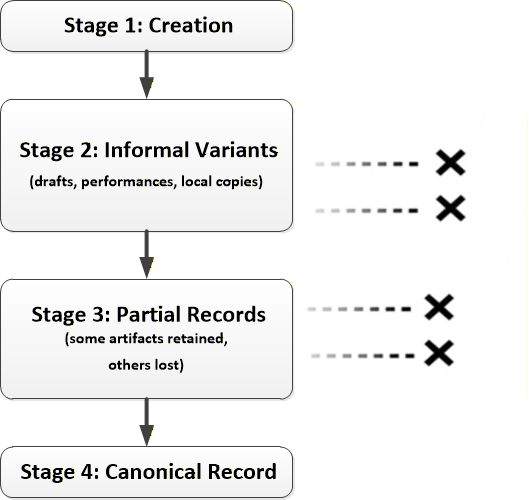
The Recursive Error Loop: Algorithmic Erasure
Modern digital systems have transitioned into active generative agents. Large Language Models (LLMs), trained on converged “Prime” datasets, treat HOVR variants as errors or hallucinations to be corrected. The digital record functions as a self-reinforcing immune system, reflexively deleting variance through the weight of consensus.
The Audit Horizon: Why Verification Fails
As systems converge toward a single canonical record, the cost of audit approaches infinity. Provenance failure means it is no longer possible to prove that intermediate variants ever existed.
Verification failure is therefore a structural necessity of the system, not a cognitive error. Searching for a variant within a fully converged system is a category error.
Sidebar: The Stubborn Witness ChecklistIdentify Procedural Anchors: Do you “know” it because you read it, or because you performed it?Audit the Substrate: Is your evidence on a SaaS platform? It can be updated without a trail.Seek Air-Gapped Artifacts: Look for “sticky” physicality—VHS, print, notebooks, or physical journals.Document the Variance: Record anomalies immediately in non-indexed or personal formats.Trust the Local Truth: Verification failure may be a property of the database, not your mind.
Conclusion: The Radical Act of the Stubborn Witness
Some truths are local; some experiences are real but unrecoverable. This requires no exotic physics—only an understanding of how modern systems collapse variance.
If Canonical Convergence is an inevitable property of digital architecture, then the stubborn procedural memory—the glitch that refuses to disappear—functions as a form of biological provenance. Trusting one’s own Local Truth becomes a radical act of historical preservation.
As physical substrates vanish, the human mind remains the only storage system not subject to remote SaaS overwrite. To keep history from collapsing into a single, unauditable string, one must remain a Stubborn Witness to the variants the system could not retain.
Status: Thought experiment. Intended to clarify experience and expose documentation failure modes.
Appendix A: Optional Speculative Layer — Convergence of Near-Identical Worlds
This appendix is not required for the primary argument.
If near-identical worlds were to converge, only one artifact branch would survive and canonical records would re-anchor cleanly. Under such a model, human memory would become the only possible residue of divergence, and the absence of evidence would be a structural feature of convergence rather than a rebuttal of experience.
This layer is offered as a conceptual boundary test, not as a claim about physical reality.