
Standing By The Record Machine - Chapter Eight
Dr. Joan Koyama trusts evidence, paperwork, and the world's version of events. Then a routine hearing triggers a feeling she cannot source.
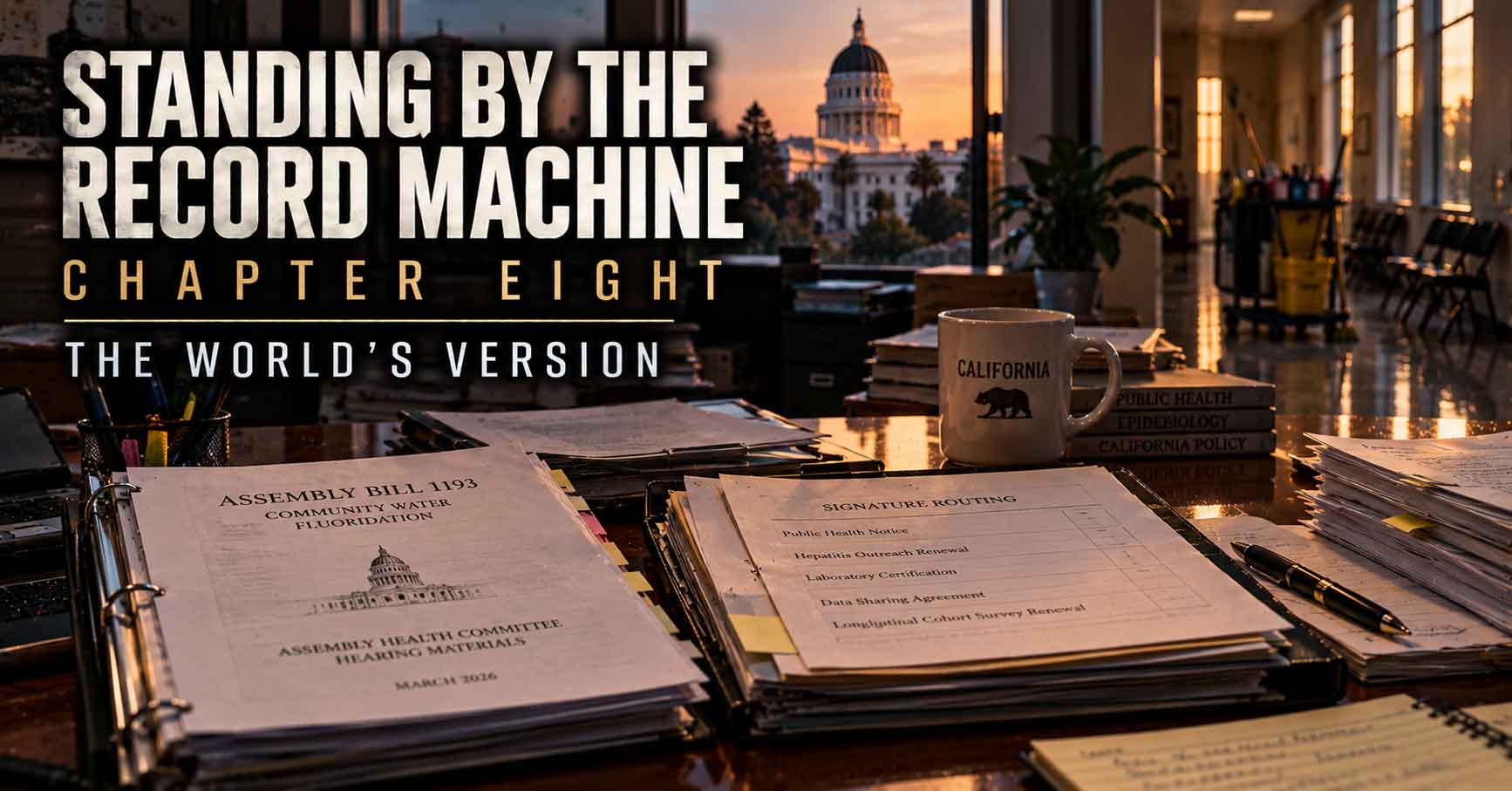
Tinkering with Time, Tech, and Culture #67
Sacramento, March 2026
The hearing room was too warm, the way they always kept it, and Dr. Joan Koyama sat at the witness table with her hands folded on a binder she was not going to need, because she had testified before this committee more times than its chairman had been in the legislature and knew her material the way you know a house in the dark.
Assembly Bill 1193 would end community water fluoridation in the State of California. Its author, a young assemblyman from the Central Valley with excellent teeth, opened on the theme of medicating citizens without their consent, to scattered applause his own staff had seeded through the gallery. Then the public comment ran its two-minutes-each parade, and then it was her turn.
She testified the way she always testified, in the language of dose-response and population baselines: fluoridation at optimal levels reduced childhood caries measurably and cheaply, and the reductions fell hardest among the poorest children, the ones for whom the water was the only dentistry they would ever get. She had brought the numbers for forty years of California schoolchildren, and she gave them cleanly, and the committee listened with the particular respect they reserved for testimony that would not change a single vote.
The assemblyman thanked her for her service and asked whether she could state with absolute certainty that fluoride had no neurological effects at any dose. She said that was not how certainty worked in public health, and gave the honest answer, margins and all, and watched him harvest the phrase not absolute certainty for the evening's press release. It was competent work. She'd have done the same in his chair.
The bill advanced out of committee, seven votes to four.
In the corridor afterward a reporter asked if she was disappointed, and she said the department would continue to follow the evidence, which was the sentence you said. A staffer she liked touched her shoulder and said, better luck in Appropriations. And Dr. Joan Koyama, deputy director, twenty-six years of state service, walked out into the March light of the capitol grounds with her binder held against her chest like a breastplate, crossed to the parking structure, sat in her car on the third level, and gripped the wheel with both hands because they were shaking.
She looked at them until the shaking was something she could have described to a physician. Then she started the engine anyway, because she had a two o'clock, and backed out of the space with her hands still going, and at the first light on L Street she returned the call her chief of staff had left during the vote, and her voice on that call, he told her months later when it was safe to, had been exactly her voice.
This was the part she could not explain, and Joan Koyama had built a career and a reputation on being able to explain things.
It was a teeth program. She could hold the whole loss in professional proportion: an incremental public health measure, eroding nationally for a decade, its evidence base solid but not sacred, its ending survivable. Children would get more cavities, most treatable. Programs ended. She had watched programs end for twenty-six years and gone to lunch afterward.
She drove back to the department with her heart going like she'd run stairs.
She had inventoried the candidate explanations the way she'd been trained to, because a reaction this size demanded a source. Career investment: modest; fluoridation was two percent of her portfolio. Political frustration: chronic, managed, never before somatic. Some family thing about water or teeth or the Valley: she had gone looking, more than once, lying awake, auditing her own history for the file that would explain the feeling, and the file was not there. That was what frightened her, though she would never have used that word. She was fifty years old and had had, in her adult life, exactly one other feeling she could not source.
She made the two o'clock with four minutes to spare.
Back in the office, the afternoon was ordinary on purpose. She reviewed a grant report. She returned the calls in the order they'd come in. At three-thirty the epidemiologist on the Tulare cluster came in without an appointment, which he was allowed to do and knew it, with a folder he did not open. Nine children in two counties, the same strain, the same week. The common exposure was a produce distributor that served six school districts, and the case interviews all pointed at it, and the lab's confirmation would not be back until Tuesday. He wanted to wait for Tuesday. He had a reason, and it was a good one, and he gave it standing up: the last time the department had gone out ahead of the lab it had named a dairy that turned out to be innocent, and the dairy was gone now, and so was the family that had run it for three generations, and he had been the one who wrote the notice.
Joan listened to the whole of it, because it deserved that, and then she gave him the shape of what he was going to do, because that was what she was for.
"Notify the districts on that distributor's route. Today. Tell the schools what we know and what we're still testing, in that order, and tell them what to watch for in a child. Don't name the distributor. Don't name anyone. Put my name on the notice, not yours." He started to say something and she said, "If Tuesday clears them, the worst we've done is make some principals read their email. If Tuesday confirms it and we sat on it, that's four more days of lunches." She was already reaching for the next thing on the desk. "Go. Draft it and I'll sign it before five."
He went. He would tell people, later, that it was the fastest he had ever been made to feel right about something he had walked in believing was wrong, and that she had not raised her voice or looked up from her desk for the last third of it.
At four, her chief of staff brought the signature folder, and she worked it top to bottom, the notice on top where she had asked for it, and under it the ordinary freight of a state department on a Thursday: a hepatitis outreach renewal, a lab certification, a data-sharing agreement, the annual renewal for a longitudinal cohort survey the department had co-funded for as long as anyone could remember. She read the notice twice and changed one word. She signed the rest without reading them, because they had been read by people she paid to read them, and she had spent the reading she had for the day on nine children in Tulare. It took nine minutes and she was never, in any way she could have noticed, aware of which of those signatures mattered, because it looked exactly like the others, which was the entire point of how it looked.
At five-forty, nearly alone on the floor, she stopped in the break room, and the janitorial cart was parked by the door with its bottle of floor cleaner, and the smell reached her, that particular institutional compound of wax and pine, and for one half of one second she was somewhere else. High windows. A room with high windows and folding chairs, and being seven years old, and a smell exactly like this one, and a feeling she could not name then or now, of having been chosen for something that was never explained.
Then it was gone, the way it always went, and she rinsed her mug and stood a moment with her hands on the counter.
Here is what nobody knew about Joan Koyama, what no one in twenty-six years of performance reviews had ever suspected. She kept a running private tally, never on paper, of moments when her memory and the world disagreed. Small things. A building lobby whose plaque had, she would have sworn, read differently the year she was hired. A song on the radio with a word in it that had always sat wrong, a tiny splinter she had stopped mentioning to anyone by age fifteen, because mentioning it made people look at you with gentle concern. She had a rule for these moments, the rule she used for everything: decide now, against yourself, and move. Say the world's version out loud so the matter was closed in the room and not just in her. Check later if checking was possible. It had never once gone her way, because the world's version had the paperwork.
She was a scientist. She knew what the literature said about memory, about confidence, about confabulation, and she believed the literature, and she applied it to herself with rigor, the way she'd apply it to any noisy assay.
The repeal bill was scheduled for Appropriations on the third Wednesday of April. She wrote the date in her book, and under it the department's next steps, all of them reasonable, and then she sat with the pen over the page and the feeling she could not source came up under her sternum again, on schedule, like a tenant.
She did what she did with it. She picked up the phone, at ten to six on a Thursday, and called the Appropriations chair's office, and got the scheduler, who was surprised, and asked for fifteen minutes with the chair before the hearing, and was given them, because she was Dr. Koyama and had never once asked for anything she did not need. She wrote the appointment under the next steps. Then she went home, and the feeling went with her, and she did not write it down, because it was not, yet, something she could do anything about.
Chapter Seven - Chapter Nine