
Standing By The Record Machine - Chapter Five
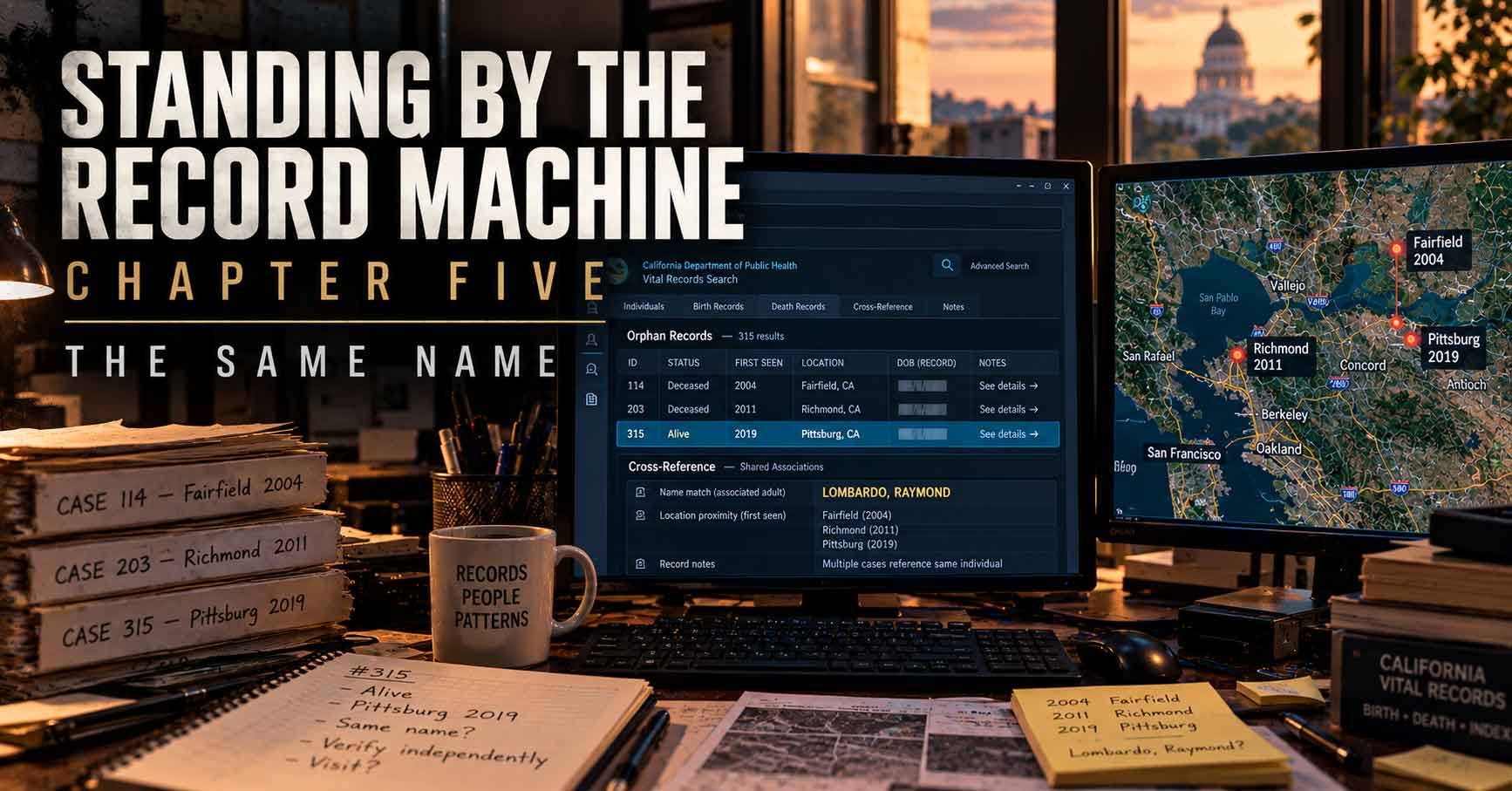
Delia finds orphan number 315, and this one is still alive. When she asks where the others first appeared, the same name keeps turning up.
Tinkering with Time, Tech, and Culture #62
Sacramento, February 2026
The fresh one came in on a Monday, and the thing that made it fresh was that it still had a pulse.
Delia found her in the weekly run, buried in four thousand discrepancies like everything else: Teresa Ruiz Coleman, fifty-seven, alive, walking around Antioch with a job and a car and a lease, a license renewal kicked out because its history didn't reach far enough back for a new federal match rule. Ordinary flag. Delia almost cleared it on sight. Then she looked at the leading edge, and the leading edge was clean, and she stopped.
Most of her orphans she met dead; a living one was a harder trick, and getting harder every year. Teresa's paper was real, a genuine 1968 birth from a real Texas county, the number resolving to it, the license to the number, the whole chain perfect root to leaf. It was everything between the paper and the present that was wrong. The number had never earned a dollar until 2019. No address before it, no clinic, no school, no lapsed subscription, no decade-old parking ticket, fifty-one years of birthday and no trace of living any of them, and then, in one autumn, a woman, fully formed.
She found the rest where she always found it, in the index filed in another building under another word. There was a Teresa Ruiz, born the same day, same county, dead in the spring of 1971. Two years old. The birth was real; the girl it belonged to had been dead since Nixon; and something was walking around Antioch wearing her name.
Teresa made three hundred fifteen, and Delia had never had one whose seam was still warm. The old ones had switched on decades ago, their first weeks worn smooth by everyone who'd stood nearby. Teresa's first week was 2019, close enough that the people who witnessed it were still at their desks.
She did not call. You worked the nine explanations, and Teresa survived them the way they all did, and somewhere around the fourth day Delia did the thing she almost never let herself do, which was get specific about the moment. The first act under the living Teresa's name was a 911 call, logged out of a cell tower in Pittsburg on September 9, 2019, at 2:47 in the afternoon. The phone company, which forgot nothing, had written it down to the second.
That was where Delia should have stopped. A count is a count. She wrote them down and she went home.
Instead she did what the forum people did, the thing she'd spent eleven years being better than, and she got curious about the place. Pittsburg. 2:47 p.m. She pulled the incident logs for that tower, that afternoon, the public ones, the ones a county keeps because a county keeps everything, and she found the 911 call, medical, resolved, and sitting eleven minutes before it in the same little geography, a second record from a different world entirely. A utility interference report. PG&E, a substation two blocks from the tower, an equipment fault that had scrambled their own telemetry for a little over ten minutes and then stopped.
And clipped to the utility report, because somebody had done their paperwork, was the name of the contractor they'd finally called to chase it down.
Lombardo, Raymond. Independent. A license number and a Vallejo address.
Delia looked at that for a while. Then she did the other thing she wasn't supposed to do, which was pull the rest of her file and ask it a question it had never been asked. Not who are you. Where were you. She took all three hundred fifteen orphans, the dead and the walking, and against each one she laid the thin public record of what else had happened in that spot at that hour, the way you'd lay a transparency over a map.
Three hundred and twelve of them gave her nothing. Noise, coincidence, the ordinary furniture of the world. Three of them gave her a name.
The same name.
Teresa in Pittsburg, 2019. A man in Richmond who had come alive in 2011 wearing the name of a boy dead since 1969, first activity logged the same afternoon a warehouse two hundred feet away lost its whole electrical telemetry to a fault nobody could source. A woman in Fairfield, 2004, activating under a dead girl's name in the same hour a distribution center's fire panel threw phantom trips all night. Three orphans, two counties, fifteen years apart, three borrowed dead names switching on beside three faults with no source, and one independent contractor from Vallejo called afterward to all three, holding a clipboard, writing down that he couldn't find the source.
It was 4:50, and Delia had a theory, and the theory was ugly and simple and she disliked how well it fit.
Dead children's names, worn by grown strangers. A man whose reports kept turning up beside the first hour of each borrowed life. You did not need eleven years at Vital Records to write the next sentence. Raymond Lombardo, independent contractor, Vallejo, was in the business of raising the dead, of matching a buried birth certificate to a body that would answer to it, and the interference reports were the cover, the reason to be on site, the electrical excuse for a van full of equipment nobody thought to inspect.
It was a good theory. It explained everything except the one thing she checked next, out of discipline, because you always ran the boring explanation before you fell in love with the interesting one.
She pulled Raymond Lombardo.
And Raymond Lombardo reconciled.
Not adequately. Perfectly. Born 1973, Vallejo, a birth record with a real hospital and two real parents and a footprint on file. School, state, federal, taxes filed late but filed, licenses, a marriage, a divorce, and the same Vallejo address running back thirty years. Thirty-one years of small honest paperwork in one unbroken braid, the kind of file she could have taught a class with, the kind that took her four minutes to walk end to end because there was nowhere it snagged. The man who allegedly manufactured people had a natural record that ran clean all the way to birth.
Which should have ended it. A forger who couldn't fake his own life into that shape wasn't a forger; a forger's own file was always the messiest thing he owned. Raymond Lombardo wasn't building anyone. He just kept standing next to it.
She was reaching to clear him, the reflex already in her hand, when the system did the small thing that stopped her cold. It flagged the record as previously reviewed. Cleared discrepancy, it said. One prior touch. And it gave her the reviewing analyst's initials, and the initials were hers.
2014, in her previous records unit, before the transfer to Vital Records. She had no memory of it, which meant nothing, she cleared a hundred flags a week and had for years. But there it was in her own shorthand, a note she'd typed and forgotten, a father's name that disagreed with itself across two old forms, and her own hand closing it. Clerical. Twelve years ago she had held some thread of Raymond Lombardo's file, given it the four-minute walk, found it immaculate everywhere but the one snagged field, and let the clean record talk her out of the snag.
This time she did not clear him. She put Raymond Lombardo in the file, the private one, the one nobody knew had a count.
She did not give him a number. The numbers were for orphans, and whatever he was, he was not one of them. The orphans wore the dead. Their paper had a grave under it and a hole behind it. Raymond Lombardo had no grave and no hole. He had a whole living braid, every year of it accounted for, a man who reconciled all the way down, and that was a thing she had never once seen and did not have a folder for. An orphan was a life with the person taken out. Lombardo was the other shape, and she didn't have a word for the other shape yet. He went into the file without a number, on a page of his own, which in eleven years she had never done for anybody.
She would have to go and look at him. You could follow a dead man forever. A live one you had to go and see.
Chapter Four - Chapter Five