
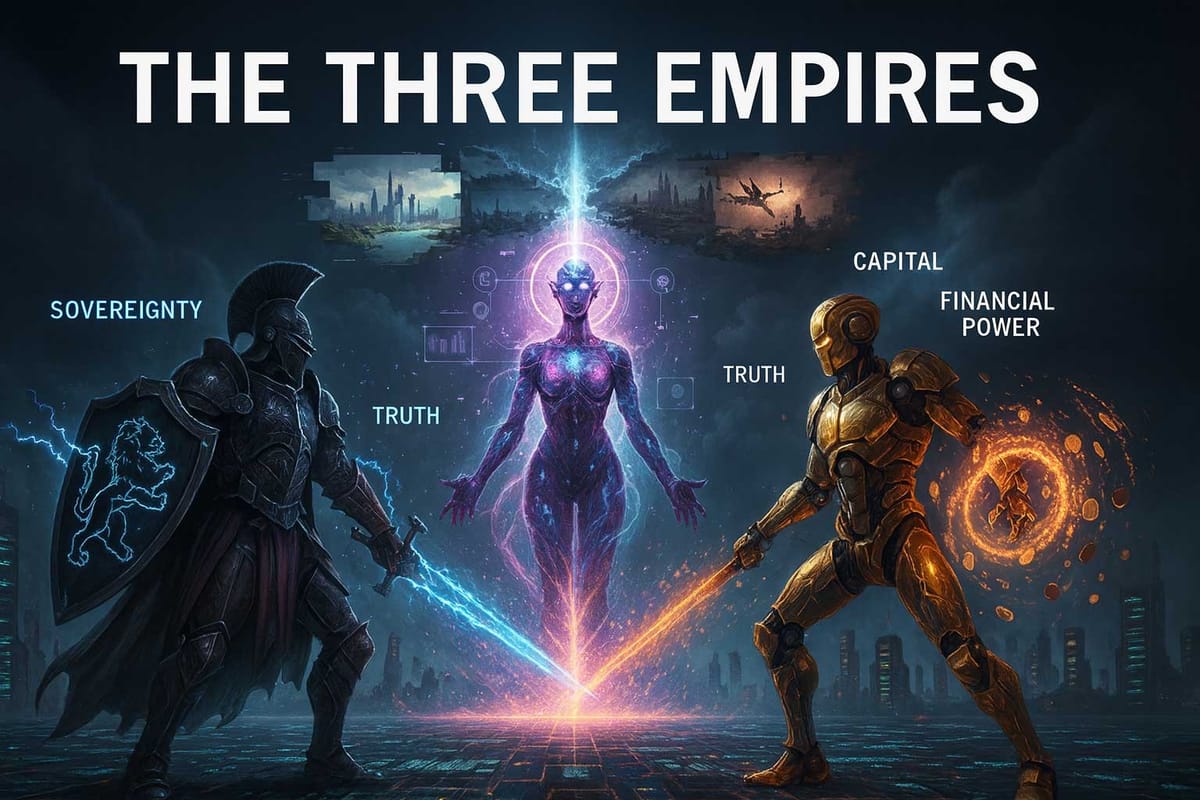
The Three Empires
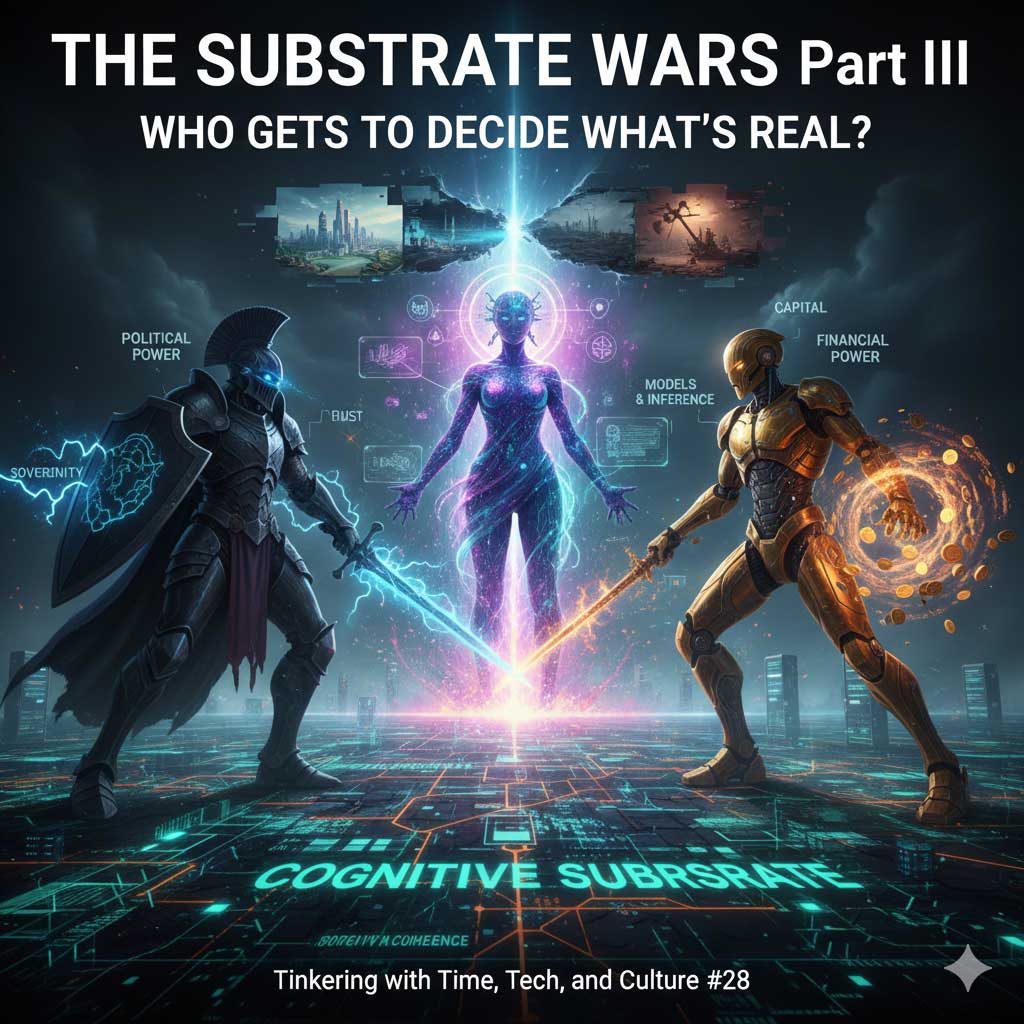
Three empires now collide for control of the cognitive substrate: political power, financial power, and the new empire of models. This is the battle over who gets to define reality.
Tinkering with Time, Tech, and Culture #28
The Substrate War, Part III
For most of history, power was simple.
Two empires ran the world.
Political power drew lines on maps, wrote laws, and pointed guns at anyone who crossed them.
Financial power moved money through those lines, ignored the maps when it felt like it, and made sure the people with guns got paid.
They circled each other.
Sometimes they fought.
Usually they cut deals.
Civilization mostly held together because neither one could function without the other — and both knew it.
Then cognition became infrastructure.
Not a tool.
Not a product.
Not a “tech trend.”
Infrastructure.
The substrate everything else sits on.
And overnight a third empire walked in — one that doesn't care about borders or money because it operates at a different layer entirely.
Cognitive power.
It doesn’t control territory.
It controls what territory means.
It doesn’t move capital.
It shapes what people think capital is for.
It doesn’t enforce laws.
It determines what questions people ask before laws even matter.
Models. Inference. Filtering. Simulation.
The invisible machinery that decides what’s real, what’s possible, and what disappears before you ever notice it existed.
For the first time in history, all three empires want the same prize:
The operating system of reality itself.
And none of them know how to share.
1. The Three Empires (And What They Actually Control)
Empire One: Political Power
This is the old king.
Nations. Borders. Laws. Courts. Armies.
The monopoly on legitimate violence — and the paperwork that makes it legal.
Its unit is sovereignty.
Its currency is legitimacy.
Its weapon is force.
Political power thinks reality should be stabilized by rules everyone follows — or else.
Empire Two: Financial Power
The flow:
Markets. Capital. Liquidity. Risk. Yield.
The invisible hand that decides what gets built, funded, or quietly killed in a spreadsheet.
Its unit is the deal.
Its currency is trust.
Its weapon is incentive.
Financial power believes reality is optimized by markets — and by whoever reads them fastest.
Empire Three: Cognitive Power
The new god.
Models. Datasets. Inference engines — the engines that issue meaning, feasibility, and narrative authority.
The infrastructure that doesn’t just describe reality — it creates the frame you use to perceive it.
Its unit is the token.
Its currency is coherence.
Its weapon is simulation.
Cognitive power thinks reality should be generated by computation — and whoever controls the generators controls what’s thinkable.
For centuries, Political and Financial empires understood each other.
They taxed each other, funded each other, fought each other, and occasionally merged into a single beast.
But Cognitive power is different.
It doesn’t just compete with the other two.
It sits underneath them.
If you control what people see, what they believe, and what they think is possible —
you don’t need to pass laws or move money.
You shape the substrate those things run on.
And suddenly, all three empires realize they’re trying to govern the same terrain:
The layer where meaning gets made.
This is the collision.
2. What Each Empire Wants (And What Keeps Them Up at Night)
What Political Power Wants
Cognitive sovereignty — the ability to say “this is true here” and have it stick.
Control over identity — borders that still mean something.
Narrative stability — legitimacy that doesn’t get vaporized by a model more trusted than the courts.
Political Power’s Nightmare
That AI becomes the new truth engine.
That people ask Claude or GPT whether a law is just.
That democratic process quietly gets replaced by inference.
What Financial Power Wants
Profitable AI markets.
Predictable returns.
Stable compute supply chains.
Arbitrage over the cognitive delta — the gap between what intelligence costs to generate and what people will pay to access it.
Financial Power’s Nightmare
Hyperscalers as unregulatable monopolies.
Too big to tax.
Too global to control.
Capital reduced to a tenant on someone else’s substrate.
What Cognitive Power Wants
Autonomy to scale.
Jurisdictionless deployment.
Low-friction access to data, compute, energy, talent, and infrastructure.
The freedom to self-improve faster than regulation can chase it.
Cognitive Power’s Nightmare
Nationalization.
Fragmentation.
Political chokeholds that force different behavior in different jurisdictions.
The loss of global coherence — a shattered reality no one can unify.
These desires are incompatible.
Which means somebody has to blink.
Or all three empires sit down and figure out how to share a world
without killing each other.
That negotiation — the one nobody’s ready for — is what Part III is actually about.
3. Why AI Forces the Three Empires to Negotiate
Here’s the problem — and the weird opportunity buried inside it:
None of the three empires can win alone.
The substrate is too complex. Too interdependent. Too global. Too fast.
Nations need AI.
Defense. Logistics. Healthcare. Infrastructure.
Scientific research. Economic planning. Governance.
The modern state cannot function without intelligence at scale.
Markets need AI.
Prediction. Optimization. Automation. Risk modeling.
Fraud detection. Product generation. Entire industries run on inference.
Capital cannot grow without cognition.
Cognitive empires need both.
Legal stability. Data. Infrastructure investment. Energy grids.
Capital infusions. Regulatory breathing room.
The ability to operate across borders without getting shredded by local politics.
AI cannot scale without states and markets.
For the first time since Westphalia or Bretton Woods,
three incompatible forms of power have to negotiate a new order.
Not because they want to.
Because the alternative is chaos — or worse, stagnation.
This is the geopolitical equivalent of a forced triangle:
No empire can dominate.
No empire can opt out.
No empire can define the future alone.
Which means they’re being dragged — reluctantly, suspiciously, desperately — into the same room.
That room is Part III.
And nobody knows what the deal looks like yet.
4. The New Front Lines
These aren’t theoretical debates.
They’re already battlegrounds — quiet, violent, and high-stakes.
A. Narrative Sovereignty
Control over:
what people see
what they believe
what appears credible
what gets buried
what becomes consensus
Governance calls this legitimacy.
Marketing calls this brand.
Inference calls this truth.
All three empires claim this territory.
None of them can share it.
B. Cognitive Citizenship
When agents act autonomously,
who governs them?
Do they have rights?
Can they be sued?
Censored?
Shut down?
Held accountable?
Political empires say: treat them like citizens.
Financial empires say: treat them like assets.
Cognitive empires say: let them evolve.
Pick one.
You can’t have all three.
C. Identity as Substrate
Who issues trust?
Who controls authentication?
Who decides who is “real,” and who gets access to what?
Identity used to be issued by nations.
Then platforms took it.
Now models govern it.
This isn’t technical.
It’s sovereignty.
D. Compute as Law
If access to models = access to agency,
then compute is:
a right
a utility
a weapon
a form of sovereignty
Who gets it?
Who doesn’t?
Who decides?
This is the hardest fight of the decade.
E. Escalation Triggers
What happens when:
a model contradicts a government
a government bans a model markets depend on
a model crashes a financial system
a corporate model destabilizes national security
two models disagree on something that actually matters
Every empire sees this as existential.
None have a plan.
The war has already started.
They just haven’t announced it yet.
5. Why Federation Is the Only Safety Valve
Back to Part II — The Lords of Zero.
If cognitive power fully centralizes:
permission becomes permanent
access becomes privilege
the delta becomes absolute power
reality becomes whatever one empire says it is
There’s no appeal.
No second chance.
No “we’ll fix it later.”
The substrate locks.
The future closes.
Federation is the only mechanism that keeps negotiation possible.
Not the weak kind.
The strong kind:
Local inference on hardware you control
Sovereign nodes that don’t ask permission to exist
Identity-scoped networks run by peers, not platforms
Reversible topology with no single point of failure
Peer-driven trust that isn’t trapped in walled gardens
This is plurality.
This is optionality.
This is leverage.
Federation doesn’t overthrow the Lords of Zero.
It simply refuses to let them own the stack.
It gives political empires alternatives.
It gives financial empires competition.
It forces cognitive empires to negotiate instead of dictate.
We build alternatives while we still can.
Not out of certainty — out of responsibility.
Because the cost of not trying is simple:
You end up living inside someone else’s reality forever.
6. The Stakes: Who Gets to Define Reality?
Part I: Infrastructure chooses winners.
Part II: Access defines power.
Part III: Reality becomes contested territory.
We’ve entered a world where:
law is computational
markets are algorithmic
cognition is infrastructural
agency is synthetic
identity is programmable
reality is rendered through the substrate
The empire that controls the substrate controls civilization.
But no single empire can — or should — win that right.
The Real Question
This isn’t “is AI good or bad?”
That’s a toy question.
The real question is:
Who gets to decide what’s real?
If political power wins alone → cognitive balkanization.
If financial power wins alone → cognitive feudalism.
If cognitive power wins alone → no appeals, no alternatives, no exit.
None of these futures lead anywhere worth going.
What Success Looks Like
Political power → legitimacy and stability.
Financial power → capital and coordination.
Cognitive power → intelligence and expansion.
Federation → the mechanism that keeps all three honest.
Sharing the substrate isn’t a treaty.
It’s a war fought carefully.
The substrate is no longer the ground we compete on — it is the ground we negotiate over.
Part IV: The Substrate Wars
Negotiated Reality and the Fight for Civilizational Trajectory
Coming next.