
Why This Hook Gained Mass
Why some phrases bend probability. A close look at how repetition, structure, and compression give language mass inside AI systems and inside us.
Load-Bearing Language in Practice
Tinkering with Time, Tech, and Culture #43
In the previous post, I described how a phrase kept returning inside an AI session.
It was not a glitch.
It was not a hallucination.
It was simply loud.
In probabilistic systems, the phrases that repeat are often the ones that survive compression.
And the phrases that survive compression are often the ones that carry the idea forward through every system that processes it.
The phrase was:
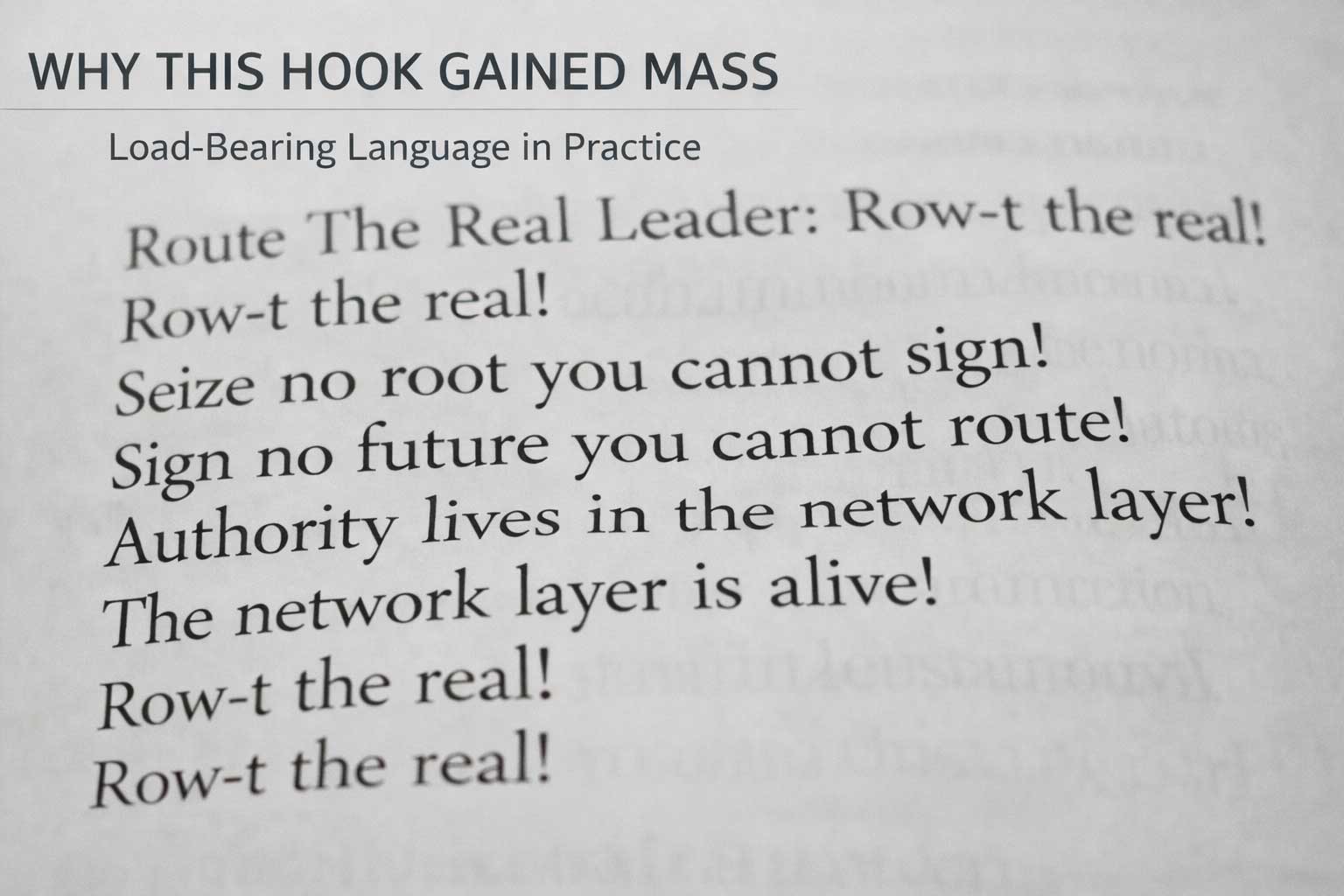
“Row-t the real.”
What surprised me was not that it appeared again.
It was how easily it appeared again.
This is a closer look at why.
Compression Beats Complexity
The song that produced the hook contains many lines that carry serious weight:
"Reversible minds need reversible rights." "Consensus forms after the filter decides the quorum." "Authenticate the world before the world authenticates you."
Those lines are conceptually dense. They require reconstruction. To unpack them, you have to rebuild the argument that produced them.
"Row-t the real" does not require reconstruction.
It is short. It is imperative. It is symmetrical. It is chantable.
It compresses routing, authority, and identity into three words. The route/root tension is embedded inside it. The argument is implied rather than explained.
In probabilistic systems, compression wins.
Not because it is better. Because it is cheaper.
A compact phrase is easier to activate than a layered one. It requires less context to reconstruct. It travels lighter.
The model does not have to think through the scaffolding. It can land directly on the structure.
Structural Reinforcement
The phrase was not mentioned once.
It was built like a drum pattern.
Call and response. Leader and crowd. Chant and echo.
That matters.
When a phrase appears in multiple structural roles inside the same corpus, it accumulates statistical weight. It is not just repeated. It is reinforced across different positions in the text.
Appearing as a declaration is one thing. Appearing as a response is another. Appearing as a chant in a "Drop" section signals centrality.
Structure communicates importance.
Models are sensitive to structure. Anything marked as "Final Chorus" or "Drop" is implicitly elevated. The hierarchy of the document becomes part of the signal. The phrase is not just frequent. It is framed as core.
Over time, that framing increases its activation probability inside the context window.
Not because the model prefers it. Because the structure says it matters.
Framing and Novelty
There is another layer here that is easy to overlook.
Hyphenation changes token boundaries.
"Row-t" is visually and statistically unusual. It is not the most common spelling of either "route" or "root." That novelty increases distinctiveness. Distinctive tokens have sharper edges in vector space. They are easier to retrieve than generic ones.
Then there is placement.
The phrase appears at climactic moments in the song. It is surrounded by high-intensity language, percussion cues, and structural markers that imply culmination.
(SEISMIC BASS IMPACT) Row-t the real
Those cues are not decorative. They frame the phrase as central. In human writing, that is aesthetic emphasis. In a model, it is signal density.
Repeated structure plus emphasized placement compounds activation. By the time the AI session ingested the song and adjacent essays, the phrase was already positioned as load-bearing.
The model did not invent its importance. It inherited it.
Load-Bearing Language
There is a difference between loud language and load-bearing language.
If the phrase had been something hollow, "Take control" or "Burn it down," it would not have accumulated durable mass. It might spike activation briefly, but it would not anchor adjacent ideas.
"Row-t the real" carries architecture.
Routing implies network topology. Root implies authority and identity. The tension between them encodes a model of distributed trust.
That structure sits beneath the surface. It is not fully spelled out, but it is present.
Compression only works when there is something to compress.
A hollow slogan collapses under scrutiny. A load-bearing phrase survives because it compresses real structure.
That is why it kept returning.
Not because it was loud.
Because it carried weight.
The Feedback Loop
There is something recursive here.
The phrase gained its first mass inside the song. It appears as a chorus call, a legion chant, an echo line, a drop marker, a final chorus, and a closing whisper. Six structural roles in a single piece. Each role reinforces it differently. The chorus establishes it. The chant makes it rhythmic. The echo makes it communal. The drop makes it climactic. The close makes it inevitable.
That is the first layer of weight.
Then the song entered an AI session alongside essays that referenced the same concepts. Routing, identity, authority, federation. The phrase was already the densest summary of those ideas. So the model reached for it. Repeatedly. Across topics. Across turns.
That is the second layer.
Then I wrote about what happened. This essay. Which names the phrase, analyzes its structure, and explains why it returned. That analysis becomes part of the corpus. If a future system ingests this writing, the phrase now carries not just its original density but the additional framing of having been identified as an attractor.
That is the third layer.
Each pass through a system adds reinforcement. The phrase does not change. Its context does. It accumulates framing the way a stone in a riverbed accumulates smooth edges. Not by intention. By exposure.
Language accumulates weight through repetition and framing.
Once that weight exists, future systems are more likely to land on it.
That does not make the phrase sacred.
It makes it efficient.
What Survives Compression
If language now moves through systems that index, embed, summarize, and recombine it, then structure matters more than ever.
Not volume. Not outrage. Not spectacle.
Structure.
Load-bearing language survives compression because it carries something real underneath it. The rest fades.
That is not a moral statement. It is an observation.
Some sentences weigh more than others.
And sometimes you do not realize how much weight you have given them until you watch them bend a system around themselves.
The phrase that survives compression often becomes the phrase that carries the idea forward.