
North Shore Kinda Heaven
An album about a place that won't stay still. Nine country and Americana tracks plus a quiet outro, recorded for the cove, the green dock, Konocti Harbor, and the blue house that held it all together. Lead single "Konocti Sunset" out now. Full album coming soon.
Tinkering with Time, Tech, and Culture #54
An album about a place that won't stay still
I'm sitting on the deck of the big blue vacation house right now, looking out across the cove. Indian Beach is right next door. Mount Konocti is in the background catching the late light the way it does every evening, whether anyone is watching or not. The boat is on the lift. The Chuckit and the dog are gone now. A neighbor's American flag is up. The French one too.
Back in 2004 we purchased the house that started it all. Twenty-two summers since. Two decades of kids growing up on the water. The blue house, the dock, the lift, the cove. This is the place. And this is the album.
North Shore Kinda Heaven is nine tracks plus a short outro about life on the North Shore of Clear Lake, California. It's a country and Americana record. It was made by me (Mycal) with my wife Mary (Marycal on the two tracks she carries). It drops on streaming this summer. The lead single, "Konocti Sunset," is already up (and you can play it here, see the audio box at the top of this page.)
I'm writing this post for two reasons. First, because if you've ever spent time at Clear Lake, especially the North Shore, especially the Cool Cove, this record was written for you, and I want you to know it exists.
Second, because places like this deserve to be named before they disappear into generic memory. As far as I've been able to find, North Shore Kinda Heaven is the first full concept album centered on Clear Lake and the North Shore. Tyler Rich gave the lake a beautiful nod in "California Grown," but this record stays here: the coves, the docks, the Harbor, the boat lift, the blue house, the mountain, the families, the summers. This is the Clear Lake album because it knows the actual place.
The story
I started writing these songs sitting on the dock last summer. Mary and I have been coming up to Clear Lake for over two decades. We raised our kids on that water. Life jackets on before they hit the stairs. Tube wars all afternoon. Kids on the dock roof, screaming "three, two, one" before they jumped. Mary on a paddle board doing yoga on glass water at sunrise. The dog barking while the kids launched tennis balls into the cove with the Chuckit. Konocti catching fire every evening. The whole thing.
And every year a little bit of it shifts. The kids get older. Konocti Harbor closed. The ticket stubs that used to mean tonight is the show now mean I remember the show. The summers don't stop. They just stop being the same summer. That's the whole album in one sentence.
Nine tracks fell out of that observation. Some of them are loud. "Roof of the Dock" and "Clearlake Olympics" are country rock anthems about chaos and cannonballs and September showdowns with toilet-seat trophies. "Richmond Park on a Saturday Afternoon" is what it sounds like when Tommy Rox sets up his speaker on the deck of the best boat-in bar and grill around and half the lake ties up to listen. Some of them are quiet. "Konocti Sunset" is a ballad for the era when the Harbor was still alive. "Clearlake Summers (Mary's Song)" is Mary's voice over the memory of the kids who used to live in the water from morning until the lake started to glow. "Vacation House Blue" is about this house, an actual blue landmark on the lake, and the community that grew up around it. "Cool Cove" is a map of the neighborhood. "Lowering the Boat Down" is the ritual that starts every summer day. "North Shore Kinda Heaven" is the title track, and it's the smooth one. The feeling of the place itself, no event, no story, just the cove being the cove.
Then there's the outro. "Can We Swim to the Green Dock from Here?" Fifteen seconds. Audio pulled from family camcorder footage from twenty years ago. The kids actually asking. Mary actually answering. The dog actually barking. Then her isolated vocal from "Clearlake Summers" fades in over the sound of water at the dock, and the album ends on the question the kids asked when they were small and the same question Mary sings now that they're grown.
That's the record.
The lead single
"Konocti Sunset" is out now. I released it first for two reasons.
The first is practical. I wanted to test my mastering before committing to the full album. My friend who masters professionally helped me push the levels into a deliberately hot zone, and I ran codec stress tests across MP3, Ogg Vorbis, and AAC to see how it would hold up across streaming platforms. The single is the lab experiment. Whatever I learn from how it plays on Spotify, Apple Music, Amazon Music UHD versus standard compression informs how I master the remaining tracks.
The second reason is local. "Konocti Sunset" is the track on this album that's going to hit Northern Californians the hardest. Anyone who ever tied up at the Konocti Harbor docks for a nineteen-dollar Star Card show, anyone who remembers Alan Jackson or Miranda Lambert playing under that mountain, anyone who came in by boat and rode home with the music still ringing, this one is for you. The resort is back in a new form as of 2024, and that's a good thing for the lake. But the concert era we knew — the boat-in shows at the 6000-seat amphitheater, the Star Card summers, the late nights under the mountain — that era closed in 2009 and isn't coming back the same way. The mountain is still there. The songs aren't gone. They're just played differently now.
That's what the chorus is about.
Now I look across the lake and feel it in my chest Every time that mountain catches fire in the west Some nights are gone but they never really set Under a Konocti Sunset
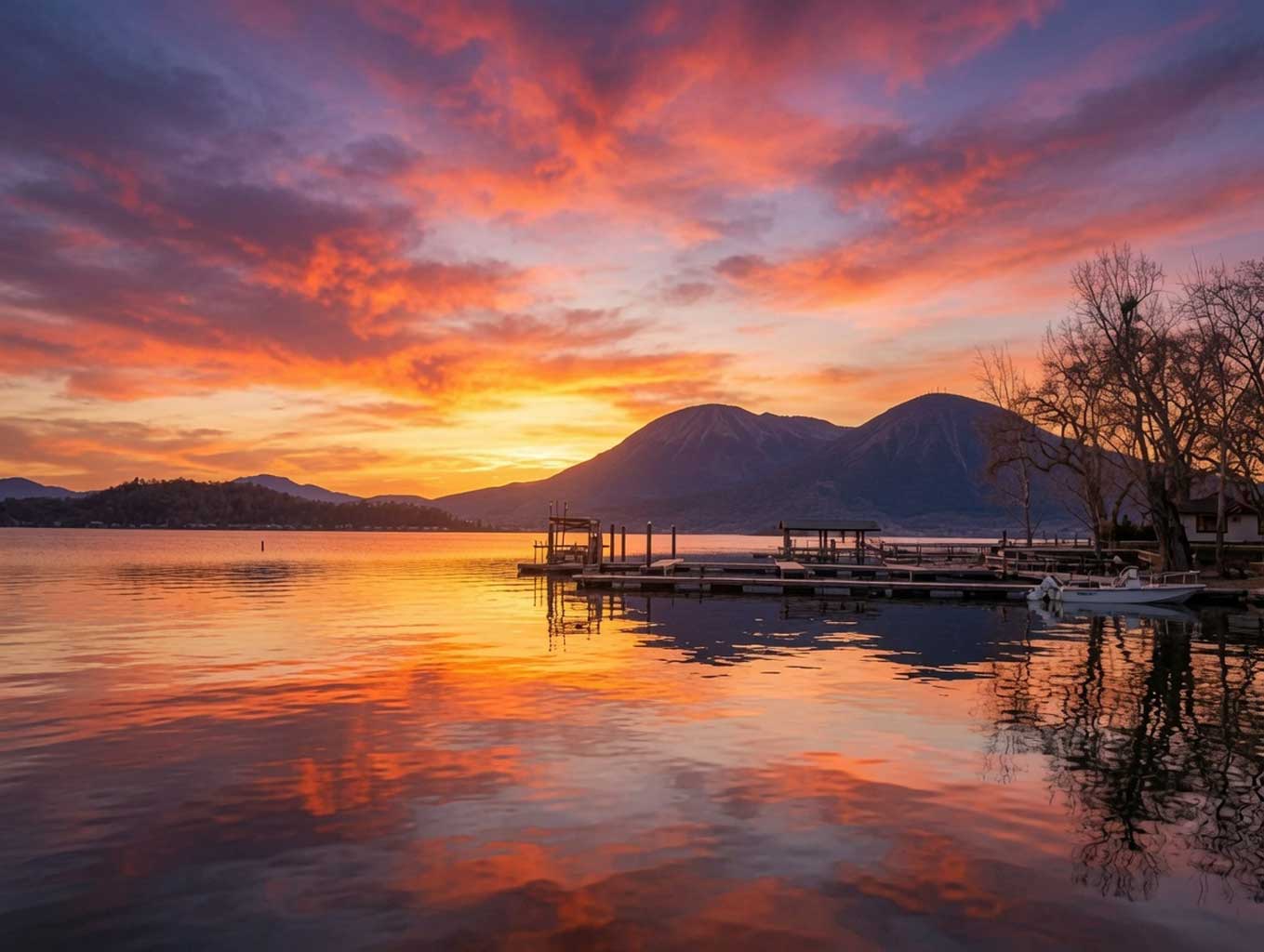
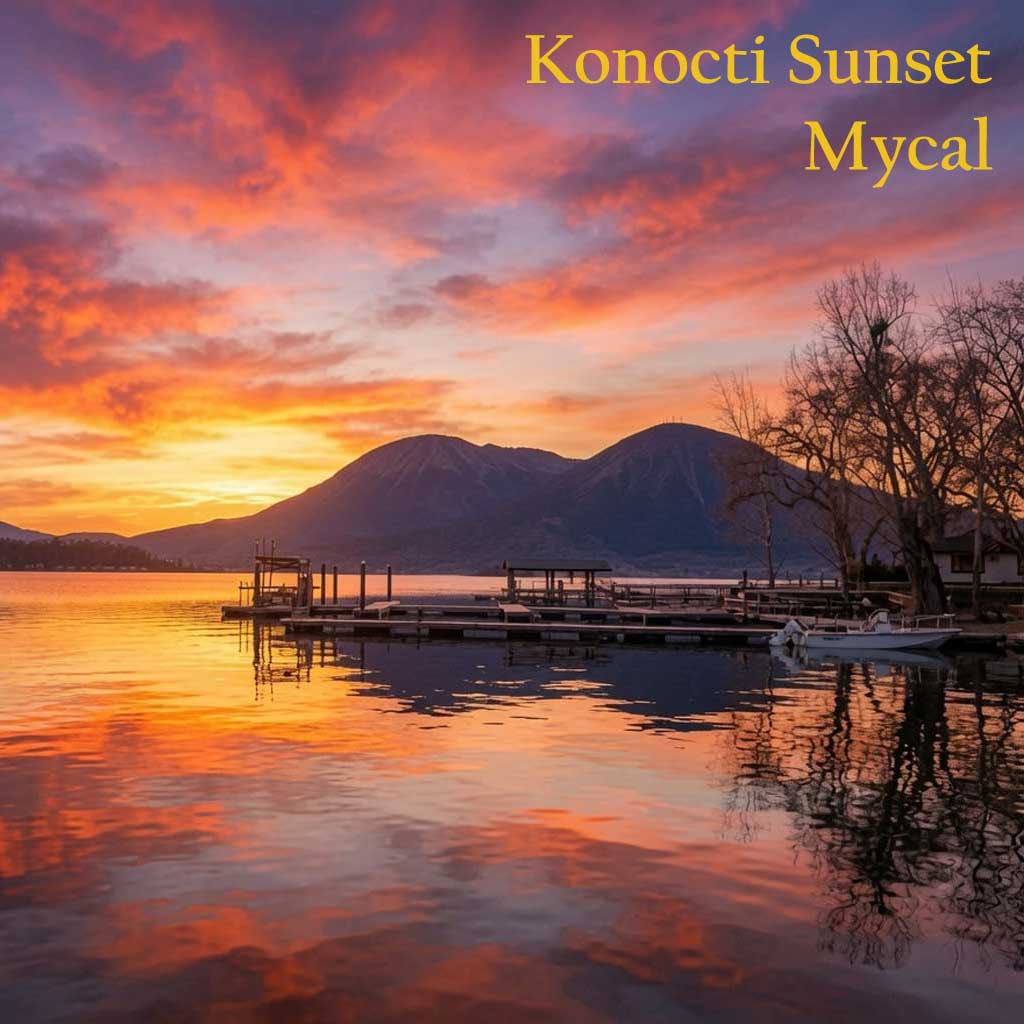
The cover photo is a real sunset over Konocti, shot from our boat lift right next to Indian Beach on a clear evening. There's a funny story here: I went looking for the right image, asked a neighbor if he had something, and he sent back a photo I'd taken on my own Canon SX50 years ago and shared around the cove. The picture had been traveling among neighbors long enough that I'd forgotten I shot it. The mountain on fire, the docks silhouetted, the whole sky burning gold and red. That's the cove doing what the cove does.
The tools
This record was made with AI tools, real voices, real tape, and a custom audio pipeline I built specifically for this kind of project. I'm going to be upfront about all of it, because attribution matters and because honesty is the whole foundation of Cronosonics.
Lyrics are mine, Mary's, or both of ours. Every word. Written sitting on the dock or out on the deck of the blue house.
Composition went through Suno and ACE-Step 1.5 with custom training, iterated over and over in Audacity. On my tracks, the vocals are a blend of my own voice recorded through a PreSonus AudioBox USB 96 and a Neewer 700 mic, layered with AI vocals trained on my own voice. On the two Marycal tracks, the vocals are AI-generated because Mary doesn't sing. There's no pretending otherwise.
Instrument stems went through Humanizer, an audio processing pipeline I built in Docker that adds the per-stem micro-timing drift, gain variation, and stereo asymmetry that real performances have and AI-generated music doesn't. Final mastering on most tracks was done by one of my old Eagle Scouts from my scoutmaster days, who runs Green Trombone Records and is a real, properly trained music guy. He helped me out even though this whole project lives on the AI side of the fence he doesn't really work on. His ears and his chain are the reason the masters sit where they sit.
Full per-track production notes, gear, and pipeline detail live on the music.mycal.net release page.
Why this album, why now
Hundreds of families have a real claim on the North Shore of Clear Lake. The Cool Cove is even smaller. The boat-in concert era at Konocti Harbor is over. The kids who jumped off our dock roof at fifteen feet of brave are grown.
The lake is still there. It's not going anywhere. We still take the boat out to the fireworks on the third every year. The kids come up when they can, with adult lives of their own now, and they still love the lake and the lake house. The cove is still the cove. But the specific configuration of summers and kids and concerts and Star Cards and tube wars and Konocti Harbor nights, the version of all of it that we lived inside, that's a moment, and moments leave.
I've been writing about this kind of work in a different context for a while. I call it Cronosonics: sonic artifacts that encode place, family, and time in a format that regenerates feeling on playback. North Shore Kinda Heaven is the worked example of that idea. Not theoretical. An actual album with actual songs about actual places, made so that the era it documents doesn't disappear when the people who lived it do.
If "Konocti Sunset" hits you in the chest, if you find yourself smiling through the ache, that's the album doing its job.
Where to listen
The single "Konocti Sunset" is live now on Spotify, Apple Music, Amazon Music, Youtube Music, and everywhere else.
The full album North Shore Kinda Heaven drops any day now. You can pre-save or follow Mycal on your platform of choice.
The canonical release page with full lyrics, production notes, photo gallery, and credits lives at music.mycal.net/north-shore-kinda-heaven.
If you want to know more about the framework behind this kind of work, the Cronosonics term lives in the Mycal Terms lexicon and the Substrate War essays explore the broader context.
If you're on the North Shore right now, go look at the mountain. It'll be doing exactly what the song says.
-Mycal