
Home Starts Showing at the Shake and Fries
A remembered night of Tokyo trains, Yokota curfews, canned chūhai, superhero street karts, and the visual mnemonic that made 立川 the first sign of home.
Tinkering with Time, Tech, and Culture #55
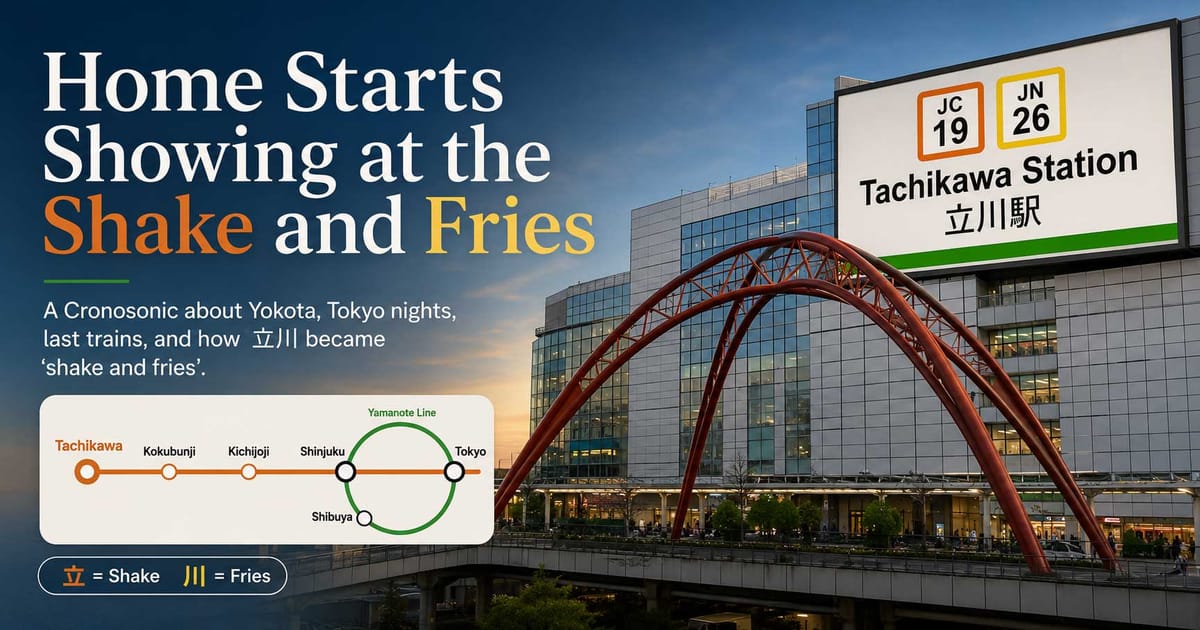
A Cronosonic about Yokota, Tokyo nights, last trains, and how 立川 became “shake and fries”
Some songs begin with a melody. Others begin with a phrase that refuses to disappear.
For me, this one began with “shake and fries.”
It was not a restaurant order. It was a way of reading a train sign.
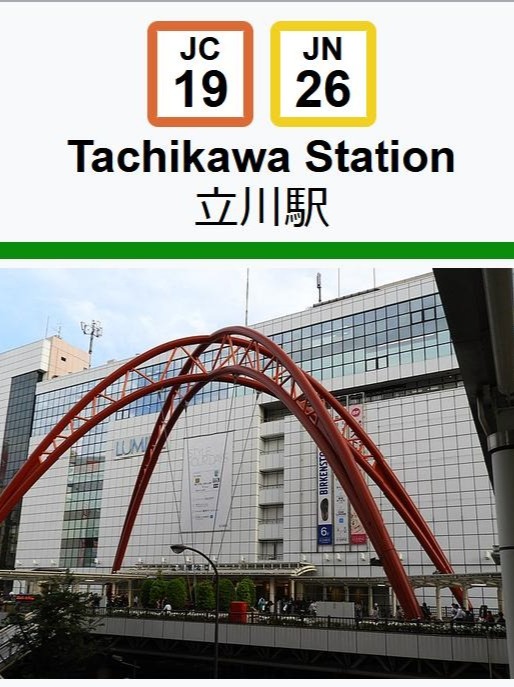
When you were trying to get back to Yokota from central Tokyo, Tachikawa was the critical transfer point. The Japanese characters for Tachikawa are 立川. Somewhere along the way, a group of young Airmen turned those characters into a visual mnemonic:
立 was the shake. 川 was the fries.
It was not Japanese class. It was not linguistically correct. It was the kind of improvised knowledge people create when they are young, far from home, running late, and trying not to miss the last train.
If you found the shake and fries, you had found Tachikawa.
And if you made it to Tachikawa, you were almost home.
That memory eventually became “Shake and Fries to Ōme,” a song about Tokyo nights, Yokota curfews, last trains, canned chūhai, superheroes, and the small signs that tell you the worst part of being lost is over.
Inside the Ring
Central Tokyo could feel like another world.
There were ticket bars, vending-machine light, Shinjuku crowds, Roppongi nights, and canned チューハイ carried onto the train. The Yamanote Line circled the center of the city in bright green, creating both a real railway loop and a psychological boundary.
Inside the ring, everything felt possible.
It could also become disorienting very quickly.
That became the central image of the chorus:
Inside the ring, 山手線の内側
Shibuya stars and Roppongi lights
終電だよ, 間に合うかな
Find shake and fries and 大丈夫さ
The Japanese and English are intentionally mixed because that is how the memory feels. You learn a phrase here, recognize a station name there, and fill in the rest with whatever language gets the job done.
終電だよ, 間に合うかな means roughly, “It’s the last train. Are we going to make it?”
That question carried more weight when there was a curfew waiting at the other end.
Superman, Spider-Man, and Rainbow Bridge
One of the most vivid parts of the song comes from driving street karts through Tokyo dressed as superheroes.
Mario-style karts crossed Rainbow Bridge. Superman was laughing. Spider-Man was lit. People at intersections turned, pointed cameras, and watched the procession move through the city.
It was ridiculous, loud, and completely unforgettable.
In the song, that memory became:
Mario karts across Rainbow Bridge
Superman laughing, Spider-Man lit
Tokyo Bay with the engines high
Helmets on under a neon sky
That scene represents the peak of the night: costumes, engines, neon, and the feeling that Tokyo itself had become part of the performance.
Then the night turns.
The uniform is folded in a backpack. Someone remembers the time. Somebody says they cannot do this anymore. The last train is no longer an abstract concern.
The city that felt limitless suddenly has an exit deadline.
The Geography of Getting Home
The route west mattered.
From central Tokyo, the goal was to get onto the right line, reach Tachikawa, transfer, and catch an Ōme-bound train toward Fussa.
That geography appears throughout the chorus:
立川で乗り換え, western air
青梅行き, take us down the line
福生まで if we make good time
立川で乗り換え means “transfer at Tachikawa.”
青梅行き means “bound for Ōme.”
福生まで means “as far as Fussa.”
These are not decorative Japanese phrases added to make the song sound exotic. They are the actual route home. The place names carry the story.
The farther west the train moved, the more familiar the world became.
That is where the line “Ōme is homey” came from. Ōme was not necessarily the destination, but seeing an Ōme-bound train meant you were finally pointed in the right direction.
Fussa was home territory. Yokota was close. The city lights were beginning to give way to morning.
Not From Books, Not From Class
The bridge explains the title directly:
立 is the shake, 川 is the fries
That’s how we learned to read the signs
Not from books, not from class
From missing trains and running fast
That may be the heart of the song.
People learn places in layers. There is the official map, the correct pronunciation, and the proper translation. Then there is the map created by experience.
That second map contains shortcuts, mistakes, landmarks, jokes, and survival phrases. It is personal, imperfect, and often more durable than anything learned in a classroom.
“Shake and fries” was part of that map.
It transformed 立川 from unfamiliar characters into recognition and relief.
The phrase also gave the song its emotional structure. At the beginning, it is almost a joke. By the final chorus, it has become a promise:
Home starts showing at the shake and fries
Tachikawa was not home. But once the sign appeared, home became imaginable again.
Writing the Memory in Two Languages
The song uses Japanese phrases without translating every one of them inside the lyrics.
That was deliberate.
Some lines communicate through context:
写真撮って — take the picture.
どこ行くの? — where are you going?
帰りたい — I want to go home.
帰ろうか — shall we head home?
大丈夫 — it is okay; we are all right.
ただいま — I’m home.
The final Japanese line brings the whole idea together:
シェイク&ポテト見つけたら大丈夫
It means, loosely, “Find the shake and fries, and you’ll be okay.”
The most grammatically complete version would normally include the object marker を, but the compressed version fits the rhythm and the way the phrase lives in memory.
It sounds less like a textbook sentence and more like something shouted between friends while moving through a crowded station.
When a Joke Becomes a Way Home
The outro arrives after sunrise.
Spider-Man is asleep by the station sign. Superman is humming. Tachikawa fades behind the train, Fussa comes into view, and the Yokota gate is waiting beyond it.
ただいま, ただいま
Fussa in the sunrise
Ōme is homey, shake and fries
Western Tokyo sunrise
By the end, “shake and fries” is no longer just a mnemonic.
It represents the strange knowledge people build together. It represents friendship, confusion, military life overseas, and the moment an unfamiliar city begins to become part of your own history.
Years later, the image was still there: two characters on a station sign, transformed into a milkshake and an order of fries.
That was enough to bring the entire night back.
And once the memory came back, the song followed it home.