
The Market Found the Kilowatt-Hour
Crypto miners are pivoting toward AI, revealing the deeper asset beneath coins, GPUs, and models: the infrastructure that turns electricity into valuable digital work.
Tinkering with Time, Tech, and Culture #56
For years we thought the market was pricing coins.
Then we thought it was pricing GPUs.
Now we think it is pricing artificial intelligence.
But underneath every one of those stories, the market is bidding on the same underlying capability.
Not software.
Not tokens.
Not models.
The ability to turn electricity into useful work.
The market didn't discover a new asset. It rediscovered the oldest one.
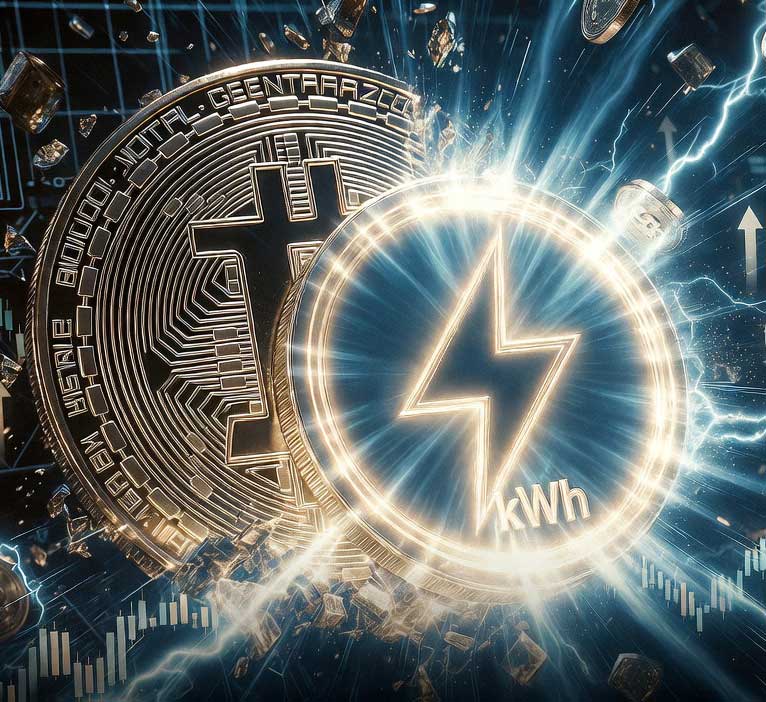
A few months ago I wrote The kWh Token, a piece about energy as the most honest unit underneath digital value. Not dollars. Not gold. Not Bitcoin. Energy.
At the time, that sounded abstract. A kilowatt-hour as a token of potential work. The ability to mine, manufacture, transport, compute, and now increasingly, to think.
But the market has a funny way of making abstractions concrete.
Crypto miners are pivoting toward AI infrastructure.
Not all of them. Not all at once. And not always in the simplistic way people describe it. Bitcoin miners are mostly running ASICs, not GPUs that can simply be redirected into AI training overnight. But the more important asset was never just the machine.
It was the power.
The land. The substations. The cooling. The fiber. The interconnects. The operational knowledge. The ability to turn electricity into useful digital work at scale.
The examples are no longer hypothetical. IREN went from pure-play miner to operating tens of thousands of GPUs, with Microsoft prepaying close to two billion dollars under a five-year capacity agreement. Core Scientific converted much of its data center footprint to multi-year AI agreements. Bitfarms went further. It announced the wind-down of its Bitcoin mining business, then rebranded as Keel Infrastructure. A pure-play miner exiting the coin to keep the power business. Even the name migrated from mining to infrastructure.
CoinShares projects in its Q1 2026 mining report that listed miners could derive as much as 70 percent of their revenue from AI by the end of 2026, up from roughly 30 percent at the time of publication. The side business is becoming the main one.
For years, crypto mining was one of the purest "picks and shovels" trades in digital assets. Miners converted electricity into hashes, hashes into block rewards, and block rewards into coins. The economic chain was simple enough to understand:
Energy → computation → crypto asset.
But AI has changed the bidding market for that same substrate.
Now the same power footprint can be used to support high-performance computing, AI inference, GPU clusters, and long-term compute contracts. That creates a new chain:
Energy → computation → cognition → enterprise value.
That is a very different kind of demand.
Bitcoin does not break because some miners leave. Difficulty adjusts. The protocol keeps moving. Issuance does not change because a miner decides that AI hosting is a better business.
But markets do not trade only protocol mechanics.
They trade confidence. They trade narrative. They trade capital allocation.
And the capital allocation signal is becoming hard to ignore.
If the people closest to the power markets, data-center shells, and compute infrastructure begin saying, "We can earn better, steadier revenue serving AI workloads than mining crypto," that is not just a business model pivot.
It is a repricing of the underlying substrate.
It suggests that the asset being priced was never the coin itself.
It was the ability to turn kilowatt-hours into whatever form of digital work the market currently values most.
The kilowatt-hour is the common denominator. The conversion capacity is the asset.
For a long time, Bitcoin represented the cleanest expression of energy converted into digital scarcity. Proof of work made that relationship explicit. You could argue with the politics, the volatility, or the speculation, but the primitive was honest: work had to be performed.
That is why the miner-to-AI pivot matters.
It is not saying that Bitcoin is dead.
It is saying that Bitcoin is no longer the highest bidder for every marginal unit of power and infrastructure.
The marginal kWh now has options.
It can secure a blockchain.
It can run AI inference.
It can train models.
It can serve enterprise compute.
It can become part of a hyperscale data-center contract.
That choice matters.
And notice who is winning the bids. The hyperscalers locking up miner capacity under long-term contracts are the Lords of Zero operating at the physical layer: capturing the gap between what a kilowatt-hour costs and what gated access to its output can charge.
The same absorption is happening elsewhere in crypto. Banks and governments are not sitting still either. They may not want "crypto" in the speculative, public-market sense. But they absolutely want tokenized deposits, tokenized Treasuries, programmable settlement, stablecoins, compliance-aware rails, and faster money movement.
In other words, tokenization may win while many traditional crypto assets lose.
The technology gets absorbed.
The speculative wrapper gets repriced.
This is the uncomfortable possibility for crypto natives: the world may adopt many of crypto's ideas without preserving many of crypto's assets.
AI takes the compute.
Institutions take the payment rails.
And the kWh sits underneath both.
That was the point of the original kWh Token idea. Energy is not just another commodity in the system. It is the system's base layer. Every abstraction eventually bottoms out in work.
Gold had to be mined.
Bitcoin had to be hashed.
AI has to be powered.
Settlement has to be computed.
Civilization keeps inventing new forms of value, but the conversion still starts in the same place: energy becoming work.
So the miner pivot to AI is more than an industry trend.
It may be the market finding the kWh token in real time.
Not as a literal coin.
Not as a new blockchain.
But as the hidden accounting unit underneath the next phase of digital infrastructure.
The market didn't discover a new asset.
It rediscovered what every new asset eventually depends on.
Energy becoming work.
The only trade there ever was.